Check These are The Best Links from Google
Showing posts with label Delta Air Lines. Show all posts

Wednesday, January 14, 2009

U.S. airline Mesa Air Group


Struggling U.S. airline Mesa Air Group (MESA.O) on Tuesday said US Airways Group (LCC.N) plans to reduce the number of aircraft it pays Mesa to fly regionally.
The carrier said the flight cuts, which are planned for January, July and next January, could continue, putting new strain on the company.


Mesa said that US Airways said it would eliminate three CRJ-200 flights by next year.
"We anticipate US Airways will continue to further reduce the number of covered aircraft in accordance with the agreement," the company said in a regulatory filing.
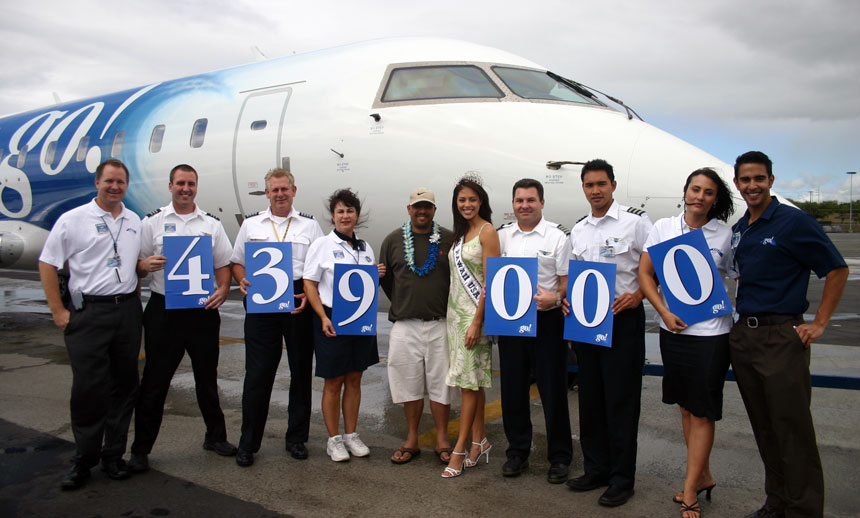
Mesa said that as of September 30, it operated 38 CRJ-900, 11 CRJ-200, and 6 Dash-8 aircraft for US Airways under a code-share agreement.


Mesa, which provides regional service for US Airways, Delta Air Lines (DAL.N) and other carriers has been looking to shore up its finances for months as it tries to ride out volatile fuel prices and a drop in travel demand.


Mesa said on Monday it received a letter from Nasdaq warning the company its stock is subject to delisting because Mesa was not in compliance with some listing requirements.
Mesa shares were down 10 percent at 26 cents in afternoon trade on the Nasdaq.

Sunday, October 5, 2008

Delta Air


Delta Air Lines Inc. said Friday that systemwide traffic and capacity decreased in September compared with the same month a year ago.


The Atlanta-based carrier said it flew 9.71 billion revenue passenger miles last month, a 0.8 percent decline from 9.79 billion a year earlier.


A revenue passenger mile is a widely watched industry measurement accounting for one paying passenger flown one mile.


Available seat miles, or capacity, fell 3.7 percent to 12.14 billion from 12.61 billion a year earlier.
Load factor, or occupancy, rose 2.4 percentage points to 80 percent from 77.6 percent.


For the first nine months of the year, Delta recorded systemwide traffic of 94.46 billion revenue passenger miles, compared to 92.83 billion a year earlier. Available seat miles rose to 115.2 billion from 114.35 billion. Year-to-date load factor was 82 percent, compared with 81.2 percent a year earlier.


Shares of Delta Air Lines slipped 36 cents, or 4.6 percent, to $7.55 in afternoon trading

Saturday, March 15, 2008

United Airlines charging $50 For a second checked Bag

Forcing customers to pay for service previously included with ticket purchases, UAL Corp.'s United Airlines and US Airways Group Inc. will begin charging $50 round-trip for checking a second piece of luggage on May 5, and Southwest Airlines Co. has already implemented a similar fee for checking a third bag. Other airlines may follow, eager to collect hundreds of millions of dollars without raising ticket prices.

Airlines are under severe financial pressure from high fuel prices, and their finances may worsen if recession curbs some travel. Carriers have been scrambling for ways to "up-sell" fliers, including selling first-class upgrades, fancy alcoholic drinks and day passes to airport clubs.

But they've also been stripping out previously free services and charging customers for anything more than basic transportation -- everything from use of skycaps and telephone reservationists to on-board meals and, at a few carriers, assigned seats and exit-row or bulkhead legroom.

Customers have adapted to most of that, and giving fliers the chance to pay reasonable fees to improve their travel experience has been popular.

Baggage fees may be different, however. The stiff penalties can add hundreds of dollars to a family vacation, especially if travelers show up at the airport with bags heavier than 50 pounds or larger than the size limit airlines use -- 62 linear inches, the combined measurements of height, length and width.

Fees for overweight and oversized bags have been raised by some airlines in the past year, even as baggage-service reliability has declined. And the fees are charged cumulatively -- an extra bag that is overweight and oversized gets hit with three fees. So a second checked bag that is overweight and oversized will cost $450 round-trip at United after May 5. At Delta Air Lines Inc., a third checked suitcase that weighs 71 pounds and is oversized costs $660 round-trip.

Baggage policies vary greatly these days. At ultra-cheap discounters like Skybus Airlines Inc. and Spirit Airlines Inc., customers pay $10 to check even one bag, but fees are generally low. Skybus charges $50 round-trip for an oversized bag, for example, compared to $100 round-trip at Southwest and JetBlue Airways Corp. and $200 round-trip at AMR Corp.'s American Airlines, United, Delta and Continental Airlines Inc. ACE Aviation Holdings Inc., a pioneer in a la carte airline pricing, offers customers a $3 discount if they don't check bags.

Beyond the potential expense, baggage fees test the boundaries of what constitutes basic airline service. What do you get when you buy a ticket, beyond transport from one city to another? Since most of us need clothes when we travel, baggage service has always been part of the deal, like a bed, shower and television in a hotel room. Is it fair for airlines to make it an add-on service the way hotels charge extra for movies, meals and telephone calls?

Some travelers say no, especially when security rules limiting liquids force many to check more bags, and weight limits and the airline proclivity to lose bags encourage people to opt for multiple suitcases.

"There's a reasonable expectation of being able to travel with the bags I need, and I think two bags is reasonable," said Joseph South of Phoenix. "It's bad enough having to weigh my bags before leaving the house, but now I have to try to miraculously put the same number of clothing changes into a trash compactor in order to condense them into one single bag."

wsjchart.gif

Wayne Peterson of Dallas is a road warrior with elite status on several airlines who rarely travels with more than one bag. But he does take his son on photographic expeditions at national parks -- with multiple bags. "The [second bag] policy seems to be one more method to nickel and dime us to death, and seems targeted at families traveling for pleasure rather than business travelers," he said.

Golfers and skiers will be hit hard by the new policies. Most airlines count a set of golf clubs or a pair of skis as one checked bag. Add a suitcase, and passengers on United and USAirways will have to pay the second-bag charge. Some extra items are exempt, such as duffle bags for military personnel and mobility devices such as scooters for disabled passengers. Many carriers automatically charge extra for scuba tanks. The rules, found on each airline's Web site, can be arcane and confusing, even getting down to fees and requirements on checking antlers, kayaks and surf boards. American, for example, allows each passenger to check one javelin for a $160 round-trip fee; Delta does not allow javelins.

United says one of every four customers checks multiple bags, and they are more likely to be leisure travelers -- who likely paid cheaper fares than other travelers. United did exempt its elite-level frequent fliers and travelers with expensive, refundable tickets from the new baggage fees. The new second-bag fee by itself will generate $100 million in annual revenue, the airline said. That's two million customers hit with round-trip second-bag fees.

Dennis Cary, United's senior vice president of marketing, says the definition of basic airline service is evolving, and different airlines today have different answers of what comes standard with a ticket.

"Unbundling" services means travelers will pay only for what they use, he says. Currently, every customer pays for baggage service, whether used or not. "We believe it has been too much of a one-size-fits-all model," Mr. Cary said.

United and other airlines believe selling extras like upgrades and better seating, along with charging for previously free services, will make the airline business more sustainable by helping carriers cover their costs. But the baggage decision was difficult, Mr. Cary said, because "changing customer expectations is obviously difficult."

US Airways, a marketing partner with United, was studying a second-bag fee when United announced its policy last month and opted to follow along beginning May 5, executives said. US Airways decided to include international travel in the new fees; United's policy applies only to domestic travel. Like United, US Airways exempts top-tier frequent fliers and first-class passengers, but all other customers have to pay even if they bought expensive refundable fares.

The airline considered charging $5 for every checked bag, but decided that would result in long lines and slower service. Since only 8% of US Airways customers check a second bag, the carrier doesn't think the new fee will clog airports. But it will generate $75 million for the airline.

"At the end of the day, it's a price increase," says US Airways Chairman and Chief Executive Douglas Parker.

US Airways spends roughly $250 million a year on baggage service, Mr. Parker says, and passing some of that cost to customers who actually use the service helps the airline offer lower basic fares. Consumers will switch airlines over even a $5 fare difference, airlines say, but are less sensitive to fees paid at the airport.

"It may be a better pricing model to segment some of the services we provide," said Mr. Parker.

That doesn't mean fees will result in better baggage handling, however, though reducing the volume of checked bags could help airlines. Last year, United ranked fifth best in baggage handling among the 10 biggest airlines, and US Airways was worst among major carriers.

US Airways says if you pay fees for baggage handling and the airline doesn't deliver, it will consider refunding fees on a case-by-case basis, likely depending on how long you have to wait for your bag to be found and delivered. United, however, says it won't refund baggage fees even if it loses your bag.
Wednesday, February 20, 2008

Delta-Northwest Combination Deal

An impasse among pilot negotiators over blending seniority lists put a $20 billion deal to combine Delta Air Lines Inc. and Northwest Airlines Corp. in "serious jeopardy" as the boards of the two companies prepared to meet Wednesday, two people close to talks told The Associated Press.

The people said the pilots unions have agreed on a comprehensive joint contract, but they are unable to agree to how seniority for the 12,000 pilots would work under a combined carrier. The people asked not to be named because of the sensitive stage of the talks.

They said late Tuesday that the pilot talks were expected to continue Wednesday, but if no agreement is reached, a deal on a combination of the two airlines would be in real trouble.

The boards of both companies were expected to vote on a combination agreement Wednesday if a pilot deal is in place by then. Otherwise, they were expected to just get an update on the merger talks, three people close to the talks said.

One of the officials close to the talks said Northwest's board might only meet by teleconference or, if things fall apart, not meet at all.

A Delta spokeswoman declined to comment on consolidation issues involving Delta. Delta has previously said it was considering a possible consolidation transaction, but it has not commented beyond that.

Talk of airline consolidation has heightened in recent months amid persistently high fuel prices, which are eating away at the industry's bottom line.

A combination of Atlanta-based Delta and Eagan, Minn.-based Northwest would create the world's largest airline in terms of traffic. That's before any divestitures regulators might require them to make if they combine.

There also has been speculation about a possible combination of Chicago-based UAL Corp.'s United Airlines and Houston-based Continental Airlines Inc., which would be a bigger airline than Delta-Northwest in terms of traffic.

The clock is ticking to get any deals accomplished quickly, some observers say. That's because industry observers believe a combination has a better chance of surmounting the considerable political and regulatory hurdles under the current administration than under President Bush's successor.

Delta and Northwest don't need a labor agreement between their pilots unions before announcing a combination, but having one in place now could help them speed up the integration of the two carriers down the line.

One of the people close to the talks said Tuesday night that a small group of Northwest seniority list pilot negotiators want thousands of young Delta pilots to go to the bottom of the combined seniority list as part of agreeing to a deal on seniority. The person said that was a major hang-up.
A spokesman for the Northwest pilots union, Greg Rizzuto, did not immediately return a call and a page to his cell phone seeking comment.

The pilots from both companies have agreed to a significant equity stake for the pilots, including raises for some, one of the people close to the talks said. However, a second person close to the talks said it was not clear that the equity issue had been resolved.

Much of the terms of how the combined carriers would operate had been resolved as of Tuesday, two people close to the talks said. The combined carrier would be based in Atlanta, would be called Delta and Delta's chief executive, Richard Anderson, would be head of the new company, the people said.

It remained unclear what role Northwest's CEO, Doug Steenland, would play in the combined carrier, the people said. A combined Delta-Northwest would maintain a substantial presence in Minneapolis and there would be no furloughs for front-line U.S. employees, the people said. The two airlines have roughly 85,000 total employees.

Tuesday, February 19, 2008

Wal-Mart beats estimates

Stock index futures pointed to a higher market open on Tuesday after Wal-Mart Stores Inc (NYSE:WMT - News) reported quarterly results that topped analysts' expectations.


The airline sector could get a boost on merger talk. The New York Times reported Delta Air Lines (NYSE:DAL - News) moved closer on Monday to a deal to buy Northwest Airlines Corp (NYSE:NWA - News), according to people involved in the talks.


Cost-conscious consumers looking for discounted prices helped Wal-Mart, the world's largest retailer, beat Wall Street forecasts.


"Any time the world's largest retailer shows better-than-expected earnings, it shows the consumer is not completely dead," said Edward Bretschger, director of equity sales and trading at Calyon Securities in New York. "Any signs of life really bode well for the economy and market in general. Wal-Mart is the ultimate litmus test for the consumer."


Another multibillion dollar write-down by a major global investment bank failed to halt the gain in U.S. stock futures. Credit Suisse (VTX:CSGN.VX - News) revealed it has written $2.85 billion off the value of its asset-backed investments and found pricing errors on its books.


U.S.-listed shares of Credit Suisse (NYSE:CS - News) were down 5.9 percent to $47.89.


S&P 500 futures (SPc1) rose 10.70 points, above fair value, a mathematical formula that evaluates pricing by taking into account interest rates, dividends and time to expiration on the contract.


Dow Jones industrial average futures (DJc1) rose 111 points, and Nasdaq 100 (NDc1) futures added 20.25 points.


The National Association of Home Builders reports the February reading of its housing market index at 1 p.m. (1 p.m. EST). Economists forecast the gauge held steady at 19 for a second month. In December, the index hit a lifetime low at 18.


On Friday, the Dow Jones industrial average (DJI:^DJI - News) was down 28.77 points, or 0.23 percent, at 12,348.21. The Standard & Poor's 500 Index (^SPX - News) was up 1.13 points, or 0.08 percent, at 1,349.99. The Nasdaq Composite Index (Nasdaq:^IXIC - News) was down 10.74 points, or 0.46 percent, at 2,321.80.

Monday, February 4, 2008

United to charge $25 for second checked bag

Starting next spring, United Airlines will begin charging certain domestic passengers for more than one piece of checked-in luggage to help offset the soaring cost of jet fuel, the No. 2 U.S. carrier said Monday.

The move by the operating subsidiary of UAL Corp. (UAUA:38.66, -2.48, -6.0%) is the first taken among the so-called legacy carriers including Northwest Airlines (NWA:17.85, -2.14, -10.7%) , Delta Air Lines (DAL:17.60, -0.93, -5.0%) and Continental Airlines (CAL:27.85, -1.40, -4.8%) , but it's bound to be imitated as a way to defray expenses without alienating fare-conscious travelers.

"They are the first, but they certainly won't be the last," said airline consultant Terry Trippler of Trippler Associates. For the airlines, each bag is additional weight and thus represents fuel expense.

"The airlines are looking for every possible revenue source they can find and still cut fares without cutting wages, because right now they can't go any lower," Trippler said.
Airlines across the industry have struggled to deal with soaring jet fuel prices while remaining competitive. Chicago-based United said the new policy is expected to generate $100 million in annual cost savings and new revenue.

In the quarter ended Dec. 31, UAL Corp. said fuel costs increased $359 million, or 25%, from a year earlier.

For domestic passengers who do not have status in a Mileage Plus or Star Alliance, a second piece of checked luggage will cost them $25, effective May 5. There will be no charge for their first bag.

United will now also charge a flat rate for all customers checking in up to four additional bags at $100 each. Previously, the airline charged in a range of $85 to $125 a bag.
Some smaller airlines already have been charging passengers for checking in more than one piece of luggage, while at least one low-cost carrier, Spirit Airlines, charges $10 each for the first two bags.

United said that, based on research into passengers' habits, it determined that only one in four check in more than one bag. By charging the 25% of people who check in more than one bag, the airline said it can bring down the weight of the airplane and help keep fares in check.
UAL's shares slipped 4.9% at last check to $39.15, in line with weakness

Saturday, February 2, 2008

Extreme Delays: Which Flights Are the Worst

Extreme delays that leave passengers trapped on airplanes for hours may seem as random as the weather. But those on-board nightmares that have garnered so much attention are more predictable than you think.

An analysis of extreme-delay data from last year shows clear patterns: Certain airlines and certain airports were more prone than others to long delays before takeoff and very late arrivals. Even certain flights had repeated trouble with very long delays.

When storms are forecast, for example, you might be wise to pack some food and tote your own water if traveling on Delta Air Lines Flight 133 from New York's Kennedy Airport to Los Angeles International Airport. That flight sat for more than three hours waiting to take off after pushing back from a gate on seven different days last year, according to data from the Bureau of Transportation Statistics. That was more than any other flight.

Delta's Flight 31 on the same route had "taxi-out" times longer than three hours on six occasions, as did Continental Express Flight 2450 from Syracuse, N.Y., to Newark, N.J. Eight other flights ended up with taxi-out delays of three hours or more five different times.
Airlines say some flights simply end up at the end of long lines more often than others because they try to depart at the airport's busiest time. But it can be more than just unfortunate timing. Airline operations managers can juggle departures because of factors like which crews may run out of duty time first, which planes are more urgently needed for their next scheduled flight, which flights have the most high-dollar business travelers who they least want to be canceled, and which flights are headed to destinations with late-night curfews -- where airlines can be fined for flights arriving after a certain hour.

Delta says its flights sat in the JFK "penalty box" -- a remote parking area for jets -- on days when thunderstorms west of New York caused air-traffic controllers to suspend westbound departures for long periods of time. The carrier will cancel flights headed to airports with weather trouble to thin out arrivals, but is more reluctant to cancel departures in bad weather cities because those flights can wait on the ground, said Neil Stronach, vice president of operations. The result is occasional long waits.

"We don't cancel to manage departure banks unless there's bad weather in the place we're going," he said.

ExpressJet, the airline that operates that Continental Express flight, says Syracuse is the closest airport it serves to Newark -- so close that Flight 2450 has a hard time getting a space in the stream of airplanes headed for Newark. "Unfortunately, the way the air-traffic-control system is designed, flights from close proximity get unfairly penalized," said spokeswoman Kristy Nicholas.

Another factor that affects extremely long sitting: Airlines are less likely to cancel flights that move on to other hubs in their systems rather than turn around and go back to the same airport they just left. If a plane is going out and back to the same hub, canceling the trip just impacts those two flights. But if the aircraft is scheduled to move on to numerous cities, canceling that flight could disrupt many more customers. As a result, aircraft that aren't scheduled for "turns" are more likely to sit and wait long periods before the flight gets canceled. (Unfortunately there's no way for travelers to get this information about their flight.)

Extreme delays are rare, but the problem escalated dramatically last year, becoming the focus of Congressional hearings and legislation. The number of flights with taxi-out times of more than three hours totaled 1,598 for the first 11 months of 2007, according to the Bureau of Transportation Statistics. (The agency hasn't released December data yet.) That's a 23.4% increase over the entire year of 2006, and December 2007 clearly added to the total for 2007 with widespread delays over the holiday season.

It's important to note that those 1,598 flights are only part of the extreme-delay problem. BTS doesn't record flights that land and then sit for prolonged periods, or flights that divert to another airport and sit.

What we do know is that of those taxi-out problems for planes waiting to take off, they often are bunched up at a few big hub airports.

JFK had 316 flights that waited more than three hours to take off last year after pushing back from a gate, according to BTS data. Newark had 202; Dallas-Fort Worth had 159, and Philadelphia, New York LaGuardia and Chicago's O'Hare each had 100 or more. Many big airports performed much better, such as Atlanta with only 31, Boston with 20, Detroit with six and Minneapolis with five.

Certain routes out of those problematic airports found themselves more often in taxi-out jail than others. From JFK, 60 of those 316 flights that sat more than three hours were bound for either Los Angeles or San Francisco. Planes flying the other direction didn't have the problem -- not a single flight in Los Angeles or San Francisco waited more than three hours to take off for JFK.

Why? To be sure, there are lots of flights from JFK to LAX and SFO, both heavily traveled routes. But airline officials say they are loath to cancel those high-revenue flights, often full of business travelers. Better to wait it out than try to rebook a big planeload of people.

Other routes with repeated problems: New York LaGuardia-to-Chicago O'Hare had 20 flights sit waiting more than three hours, and 14 in the other direction; Philadelphia-to-O'Hare also had 20 flights with taxi-out times greater than three hours, and five headed from O'Hare to Philadelphia.

Certain airlines also were more willing to wait than cancel. JetBlue Airways customers were the most likely to suffer taxi-out more than three hours, based on the percentage of the airline's flights that suffered three-hour taxi-out nightmares, followed by Continental and ExpressJet.
JetBlue also had the longest average delay last year, according to FlightStats. When a JetBlue flight was late, it arrived 67 minutes past its scheduled arrival time at the gate on average, according to FlightStats.

JetBlue says JFK, its home base, struggled with lengthy delays last year on stormy days, and delays were exacerbated for flights that departed in the early evening when international flights to Europe were also trying to take off.

Flight-crew and curfew issues can affect JetBlue's departures, a spokesman noted. Flights destined for airports like Long Beach and San Diego in California, both of which have late-night curfews, can move ahead of other aircraft, leaving others to wait longer, so that the airline doesn't get fined for curfew violations, spokesman Bryan Baldwin said. "We might prioritize different departures based on a variety of factors," he said.

JetBlue also says it has shifted its strategy to cancel more flights in advance to reduce long delays rather than trying to operate every trip, no matter how long it takes